

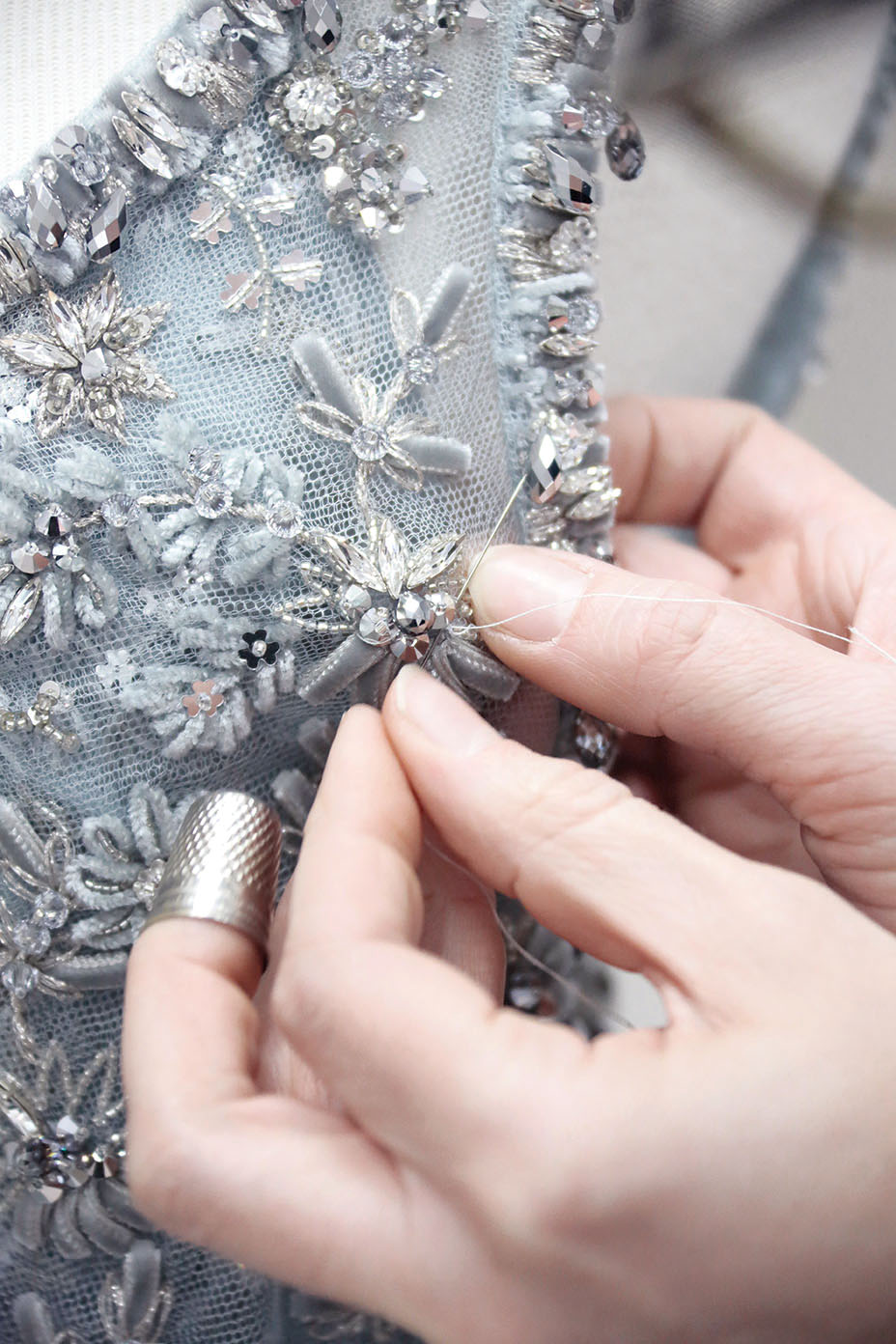
Embroidery is an ancient craftsmanship technique which allows to decorate fabric or other materials using a needle to apply thread or yarn. It may also incorporate other supplies such as pearls, beads, feathers, and crystals. In modern days, embroidery is usually seen on caps, hats, coats, blankets, shirts, denim, dresses, stockings, but it can also be applied on furniture. Embroidery is available with a wide variety of thread or yarn color.
Chanel Haute Couture dress with allover floral details. Made of organza and silk tulle and required more than 1,000 hours of work and 20 people to complete it. Photo: ©Hollywood Reporter
Some of the basic techniques or stitches of the simplest embroidery are chain stitch, buttonhole or blanket stitch, running stitch, satin stitch and cross stitch. Those stitches were the first to appear and remain the essential techniques of hand embroidery today.

Making Of Chanel’s Winter-Fall 2014/2015 Haute Couture Collection. Photo: ©Chanel
The process used to tailor, patch, repair and reinforce cloth promoted the development of sewing techniques, and the decorative possibilities led to the rise of embroidery art. Definitely, the steadiness of basic embroidery stitches nowadays is remarkable.

Photo: ©Vogue

Photo: ©Zaheer Abbas
In embroidery’s evolution there were no changes of materials or techniques which can be felt as true advances from a primitive to a more refined phase. On the other hand, we often find in early works a technical accomplishment and high standard of craftsmanship rarely attained in later times. That’s why the precious ancient knowledge of this art must be preserved.

Chanel Workshops. Photo: ©Philippine Tatler
The art of embroidery is found worldwide. Works in China have been dated to the Warring States period (5th–3rd century BC). In a garment from the Migration period in Sweden (300–700 AD) the edges of bands of garnish are reinforced with running stitch, back stitch, stem stitch, tailor’s buttonhole stitch, and whip-stitching, but it is uncertain whether this work simply reinforced the seams or should be interpreted as decorative embroidery.

Master Artisans Working. Photo: ©Surface mag

Givenchy Haute Couture Silk Evening Gown with Beading. Photo: ©1stdibs
Ancient Greek mythology stories used to tell that the goddess Athena was the protector of the embroidery and weaving arts. She later would compete for the title of the best embroiderer and weaver against Arachne, a young and beautiful mortal.

Photo: ©Chanel
Stay with us to find out more about ancient arts essential in contemporary design like embroidery, the most treasured by the outstanding designer Karl Lagerfeld.

Karl Lagerfeld. Photo: ©Philippine Tatler
See More Related Stories
Karl Lagerfeld Legacy: a Tribute to Métiers d’Art and Fine Crafts





I do not even know how I finished up right here, however I believed this put up was once great. I do not realize who you’re but definitely you’re going to a well-known blogger if you happen to aren’t already 😉 Cheers!
you’re really a good webmaster. The website loading speed is amazing. It seems that you’re doing any unique trick. In addition, The contents are masterwork. you have done a wonderful job on this topic!