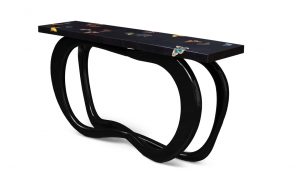
Gilding, and Leaf Gilding specifically, is one of the most luxurious ancient crafting techniques. It is a decorative technique in which master artisans apply a very thin coating of metal, usually gold, to solid surfaces such as metal, wood, porcelain, or stone. A gilded object is also known as gilt. Metal is the most common surface to be gilded. In the West, silver was often used in several objects, however, in China, bronze gilding was more frequent.

Photo: ©Harp Spectrum
Gilding gives an object a golden appearance without making it cost as much as a solid gold object. In addition, a solid gold piece would often be too soft or too heavy for practical use. A gilt surface also does not tarnish as silver does.

Fox Hunter in Tricorn Hat (20th century). Photo: ©1stdibs
Partial gilt objects are only gilded over part of their surfaces. This may mean that all of the inside, and none of the outside, of a chalice or similar vessel is gilded, or that patterns or images are made up by using a combination of gilded and ungilded areas.

Gilded Egyptian Mask. Photo: ©The Museum of Fine Arts (Houston)
Herodotus mentions that the Egyptians gilded wood and metals, and those artifacts can be found in archeological explorations. Some Ancient Greek statues of great prestige were chryselephantine: made of gold (for the clothing) and ivory (for the flesh). These were created with sheets of gold over a timber framework.

Chryselephantine statue by Carrier-Belleuse. Photo: ©Live Journal

Detail of the Chryselephantine statue. Photo: ©Live Journal
Impressive ornamental gilding was also used in the ceiling of the Propylaea. There are records that say the first gilding seen at Rome was after the destruction of Carthage, under censorship, when the Romans began to gild the ceilings of their temples and palaces. The Capitol was the first place on which this process was used.

Iowa State Capitol. Photo: ©Manetti
However, everyone wanted a piece of that luxury so quickly, private and poor people, gilded their walls, vaults, and other parts of their homes. Due to the thickness of the gold leaf used in ancient gilding, the traces of it that remain are remarkably brilliant and solid. Fire-gilding of metal goes back at least to the 4th century BC, and was known to Pliny, Vitruvius and in the Early Medieval period to Theophilus.

Jakki Godfrey, a contract objects conservator, uses a special solution to remove dirt, grime, and copper corrosion from 210-year-old pillars from the Pierr-Philippe Thomire surtout de table. Photo: ©Cooper Hewitt
In Europe, silver-gilt was always more common than gilt-bronze, but in China the opposite was the case. The ancient Chinese also developed the gilding of porcelain, which was later taken up by the French and other European potters.

Wine cooler for half bottles, 1754. (Royal Collection Trust). Photo: ©The French Porcelain Society
By the nineteenth century the mercury-gilding process had remained effectively unchanged for over one and a half thousand years, but it became obsolete due to the introduction of galvanic gilding. Nevertheless, the extinction of mercury or fire-gilding was not sorrowed, because the poisonous fumes released during the process were a health threat not only to the workers, but also to those living in the neighborhood of any gilding workshop.

Sword Hilt ( 1881–82) designed and modeled by Albert-Ernest Carrier-Belleuse. Created by the goldsmith Lucien Falize. Photo: ©Met Museum
Theophilus, who wrote in the twelfth century, already knew of the risks inherent to the procedure, yet concern over these only truly appeared massively when the Society of Arts in England offered a prize in 1771, followed shortly by the Académie des Sciences in Paris, for a solution that would reduce the risks of fire-gilding. Despite what one might think, it wasn’t public concern, but technological advance which brought an end to the use of amalgam in gilding.

Panther Sculpture gilded with gold leaf and with eyes in swarovski crystals. Photo: ©1stdibs
Until then, fire-gilding was really widespread in Europe and Asia for at least 1 500 years. It was afterwards replaced by electroplating. The origins of gilding as the application of a layer of gold to the surface of a less rare metal go back at least 5 000 years, to the beginning of the third millennium B.C.
Leaf Gilding in specific is a time-consuming technique and despite water gilding being one of the most difficult methods, it remains unchanged for hundreds of years. Thanks to it wonderful masterpieces were born, from statues to frames. Gustav Klimt is one of the most celebrated artists who incorporated this technique into his paintings, evoking Renaissance.

“Portrait of Adele Bloch-Bauer” by Gustav Klimt. Photo: ©Vogue
Gold Leaves are created from gold that is hammered into thin sheets by goldbeating, then they will be used for gilding. The most commonly used gold is 22 karat yellow gold, while pure gold is 24. Even though gold leaf is a metal leaf, usually the term metal leaf is used while referring to other metals.
Stay with us to learn more about this fascinating ancient art.
See More Related Stories